There are quite a few varieties available now and last week I bought two 'Queen Mum' agapanthus, a blue and white variety:
 |
Agapanthus orientalis 'PMN06' |
I also love the agapanthus Bressingham Blue, but I'm not sure that it's available in Australia:
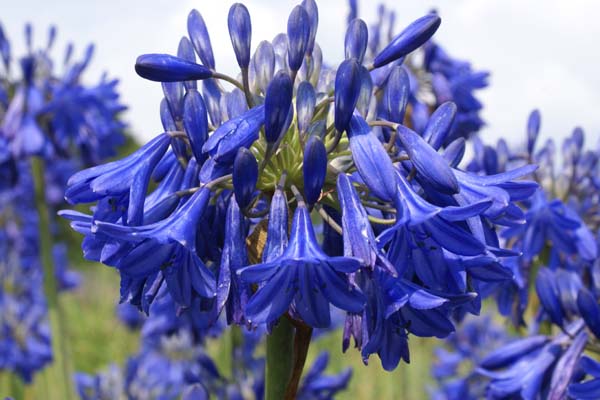
I was pleasantly surprised to see agapanthus at Sissinghurst, near the purple border. The White Garden features white ones in July.
Today I 1threw a couple of handfuls of cow manure around each of the front garden roses and then watered with Seasol. I planted a white Lavandula pendunculata, referred to as "butterfly lavander" because of the petal wings that appear above the foliage. I also planted some Pansy x wittrockiana in front of the lobelia, which are a gorgeous vivid blue (of course). I just read that lavanders should be given a yearly feed of Calcium and Magnesium, both present in dolomite lime.
A violet transplanted from the family home in Burradoo is thriving around a camellia grown from a cutting in the same garden:
Today I 1threw a couple of handfuls of cow manure around each of the front garden roses and then watered with Seasol. I planted a white Lavandula pendunculata, referred to as "butterfly lavander" because of the petal wings that appear above the foliage. I also planted some Pansy x wittrockiana in front of the lobelia, which are a gorgeous vivid blue (of course). I just read that lavanders should be given a yearly feed of Calcium and Magnesium, both present in dolomite lime.
A violet transplanted from the family home in Burradoo is thriving around a camellia grown from a cutting in the same garden:
 |
| The camellia is middle top and the plant in the foreground with oval leaves is a blueberry.
The success of the violet has prompted me to think about using more ground covers as mulch. There are lots to choose from, for example Ajuga reptans, Vinca minor (periwinkle), and Geranium macrorrhizum. I have some Lamium maculatum, again from cuttings from Burradoo and some geranium, the latter of which is very pretty but dies if not watered for too long. Any groundcover I choose will have to be tough, because it will live under the Camellia sasanqua hedge that borders three sides of the back garden and will have to survive on rain-water after it has settled in.
|


No comments:
Post a Comment