Thursday, August 21, 2014

Lessons learned

The Queen Anne's Lace (QAL) and Nigella seeds have germinated, but not the Blue Lace Flower (BLF). The BLF seeds are in the same mini-greenhouse as the QAL and I need to give the QAL some air now but not the BLF. So lesson-do not sow two different types of seed in the same mini-greenhouse because they may germinate at different times and then need different conditions to grow.

The Nigella seedlings have little furry things on them which I really hope is not mould. It has been teeming with rain now all day and so the now uncovered QAL seedlings will be saturated, which will pre-dispose them to rot. It's amazing anything survives at all, really, especially with me looking after them.

Queen Anne's Lace seedlings. If I leave the plastic mini-greenhouse lid on now they have germinated, then will grow long and thin trying to reach proper sunlight. 

Nigella seedlings. Apparently they hate being transplanted. I didn't read that bit of the instructions until after I sowed them in the tray.

Yesterday I ordered more Russian Sage, again because I failed to read the whole blurb when I ordered the first one, which explained they looked better and fared better in groups. I also ordered A
"Sweet Lili", also known as Hummingbird Mint, which is a gorgeous pink tinged with apricot. 
Image: http://lambley.com.au/plant/agastache-sweet-lili
I am trying to decide on a white climbing rose for the sort-of white garden next to the front fence and after much research have decided a white Iceberg is probably the best option. I have a mental picture of a garden connoisseur friend rolling her eyes when she reads this, but the other roses I have looked at are not sufficiently white or may not suitable for Sydney's humidity. I would rather not learn the hard way while watching black spot decimate the plant. Here is a Mlle Sombreuil:


Very pretty and Old Rosey, but too cream. Another lovely one is Lemarque:
http://www.treloarroses.com.au 

This Claire Austin is lovely. Grows 1.5m high and can be trained as a moderate climber:
http://www.treloarroses.com.au/
And here is the Climbing Iceberg:
http://www.love-of-roses.com/Iceberg.html

Sunday, August 10, 2014

Agapanthus et al

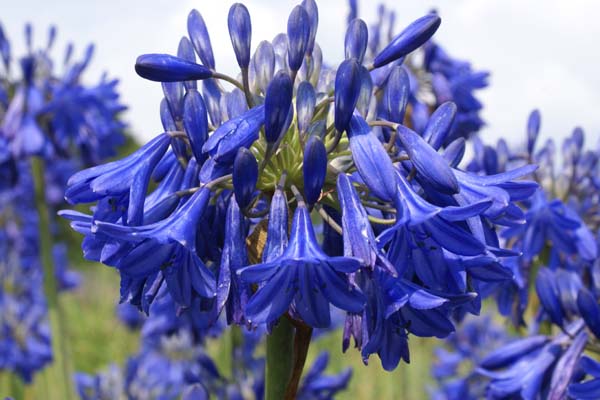
We take agapanthus for granted in Australia. It is everywhere and classed in some parts as a weed, so the eye just passes over it. I looked at agapanthus anew when I was researching blue plants. They are also known as 'Lily of the Nile', which is romantic, but innacurate, considering they come from South Africa and I remember reading they were brought to Australia with the First Fleet.

There are quite a few varieties available now and last week I bought two 'Queen Mum' agapanthus, a blue and white variety: 

Agapanthus orientalis 'PMN06'PBR Protected. Serious penalties apply.

I also love the agapanthus Bressingham Blue, but I'm not sure that it's available in Australia:

I was pleasantly surprised to see agapanthus at Sissinghurst, near the purple border. The White Garden features white ones in July.

Today I 1threw a couple of handfuls of cow manure around each of the front garden roses and then watered with Seasol. I planted a white Lavandula pendunculata, referred to as "butterfly lavander" because of the petal wings that appear above the foliage. I also planted some Pansy x wittrockiana in front of the lobelia, which are a gorgeous vivid blue (of course). I just read that lavanders should be given a yearly feed of Calcium and Magnesium, both present in dolomite lime.

A violet transplanted from the family home in Burradoo is thriving around a camellia grown from a cutting in the same garden:

The camellia is middle top and the plant in the foreground with oval leaves is a blueberry.

The success of the violet has prompted me to think about using more ground covers as mulch. There are lots to choose from, for example Ajuga reptans, Vinca minor (periwinkle),  and Geranium macrorrhizum. I have some Lamium maculatum, again from cuttings from Burradoo and some geranium, the latter of which is very pretty but dies if not watered for too long. Any groundcover I choose will have to be tough, because it will live under the Camellia sasanqua hedge that borders three sides of the back garden and will have to survive on rain-water after it has settled in. 


Sunday, August 3, 2014

Blue Annuals-3 August 2014

Sowing seeds is much, much cheaper than buying plants but it also requires a bit of effort at different stages. If you're like me, the biggest effort is remembering to water the seeds once they're sown, rather than becoming distracted by work or other pass-times, then wandering out to the potting area weeks later to see dry dirt and not one speck of green. Writing this post is part of my attempt to remember my little seeds, the other method being post-it notes and crossed fingers.

The green lid on the bottle is specially designed so you can sprinkle water gently onto seeds so as not to displace them. 
I usually buy proper seed-raising mix which contains fertiliser and fine particles which adhere better to the seed. I buy the mix, but here is a recipe for home-made mix. I sowed Trachymene coerulea (Blue Lace Flower), Nigella damascena (Love-in-a-Mist Blue) and Ammi majus (Queen Anne's Lace). The nursery from which I bought the seed states that you can "sow direct", meaning you just sow it straight into the garden where you want it to grow, however that rarely works for me, because you MUST keep the seeds moist, otherwise they won't germinate. Not sopping wet, either. Just moist. 

I cast the seed on top of the mix, then patted it down and sprinkled a fine layer of mix over the top of some and vermaculite on others. I want to compare to see if one method is better than the other. Then I thoroughly moistened the seeds and mix and placed a mini-greenhouse over them to keep them warm. When the seeds germinate, I will prop the lids of the greenhouse open to give the baby plants some air. 

Place the trays in bright light out of direct sun.
By H. Zell (Own work) [GFDL (http://www.gnu.org/copyleft/fdl.html) or CC-BY-SA-3.0 (http://creativecommons.org/licenses/by-sa/3.0)], via Wikimedia Commons

Nigella damascena by Louise Docker from sydney, Australia (Twisted) via Wikimedia Commons
Flower, Blue lace flower - Flickr - nekonomania

Saturday, August 2, 2014

When life gives you lemons

Lemons are synonomous with the Mediterranean, but it wasn't always like that. It was not all that easy to find reliable information on the history of the lemon in the Mediterranean on the internet. I have read some of my gardening encyclopedias and hunted down articles and it seems that lemons were not known in ancient Rome and Greece. Theophrastus, Aristotle's successor and the first man to attempt to create a taxonomy of plants, doesn't describe lemons, but he does describe citrons, a huge, thick-skinned fruit that was either revered or reviled. Lemons are not mentioned in the bible, either, but citrons are. 

So the "lemon trees" that I found when I googled "lemon trees in ancient Roman frescoes" are probably citron trees, or even quince trees. Probably quince trees, actually. The picture below was taken in the Villa of Livia in Rome, which was first built around the first century BC. 

"Livia Prima Porta 08" by Miguel Hermoso Cuesta - Own work. Licensed under Creative Commons Attribution-Share Alike 3.0 via Wikimedia Commons
Lemons were introduced to Europe by the muslims and were grown in Sicily by 1000AD. The ancients did, however, have vinegar and perhaps thats how they satisfied their taste for sour things. 

A year or two ago I hard-pruned my lemon tree and this year I harvested a ridiculous number of lemons. Now to use them. This weekend I will make a joue de boeuf en daube provencale, beef stew with lemons. I made a honey and lemon mask this afternoon, which is supposed to lighten the skin and fight pimples. My pimple days are over but it tasted yummy and felt quite decadent. 

I am going to make some lemon marmalade and lemon infused olive oil. For the latter, just simmer the zest of one lemon in 3/4 olive oil for about 20 minutes, then strain the oil into a jar or bottle and store in the fridge for up to two weeks. The recipe is from a gorgeous site called Souvlaki for the Soul and contains beautifully composed photos as well as great recipes. I will also make some preserved lemons, using a recipe by Claudia Rodin.


The bright green branches start where the branches were pruned


Wednesday, July 30, 2014

Lobelia erinus

Today I bought five lobelia erinus for $10 (Aus). There were no labels on the pots, so I'm not sure what cultivar they are, but one was a bluey-purple and the others an intense ultramarine, my favourite colour. They are native to southern Africa and I am yet to find a photo on the internet that does justice to their colour. Here is a photo I took the other day of a neighbour's lobelia. 

This Wikipedia article describes the different shades of blue. The ultramarine originally used in painting was made from high quality ground lapis lazuli from Afghanistan. It was very expensive and artists usually needed wealthy patrons to buy it for them. The pigment was often used to colour the Virgin Mary's robes in paintings. The painting below, by Sassaferrato, appears in the National Gallery's Making Colour exhibition, which examines colour in art. 

Ipomoea purpurea, or Morning Glory is no doubt classed as a weed in Sydney, but the colour of the flowers is divine. 

Cobalt blue pots can make a nice contrast in the garden. Might try some deep orange nasturtiums and sapphire coloured lobelia trailing from a blue pot. The Empress of India nasturtium is a dark, rich orange. Here is a photo from the Diggers Club website:


If you have a garden and a library, you have everything you need

The title is a quote by Marcus Tullius Cicero, a Roman consul, lawyer, orator, philosopher and presumably, lover of gardens. My last two sessions of gardening have been enlivened by a series of lectures by Professor Garrett G. Fagan on the History of Ancient Rome. Professor Fagan presents a well-paced overview of the long history of Rome and there is not one dull minute.

Today I planted the salvia nemorosa, perovskia atriplicifolia and nepeta "Six Hills Giant".
I am instructed to cut the nepeta to the ground after Christmas and in late autumn.

Rose feeding

I've read lots of different advice about feeding roses. I'm going to try the advice given by Magic Garden Roses, which is to feed in September, December and February with a four in one mix consisting of chicken manure, seaweed extract, fish meal and blood & bone and mulch with cow manure. I'll mulch with lucerne hay.


Monday, July 21, 2014

Initium Novem

Last year's post-Sissinghurst enthusiasm didn't last long. The other day I was casting around for a word to describe my attitude to gardening and T volunteered, "desultory?" I was thinking more of inconstant. Or sporadic. Months will go by when I barely look at the garden because I am busy at work or busy lying down reading, but then months will go by when I can hardly wait to get into the garden and I'll spend hours and hours out there, usually pulling out the weeds that have taken advantage of my absence.

Presently I am in gardening mode and  I hope it lasts. I am going to try and be more systematic in my approach. Favourite bits of gardening are: weeding, trimming and pruning. There is something therapeutic about ripping weeds out of the ground and snipping off ungainly bits of plant. Quite like planting things, preparing cuttings and sowing seed, but so often seeds have failed to germinate or died when tender seedlings because I forgot about them. So. New beginning, which sounds better in Latin.

Also starting Latin lessons learning about Ancient Rome, so I am going to make an effort to learn the Latin names of plants.

Last Saturday I pruned most of the roses. This included a radical renovation of the Cecil Brunner out the front.

I also ordered some new perennials from my new favourite nursery, Lambley Nursery in Victoria. Three nepeta x faassenii  'Six Hills Giant', three salvia nemorosa 'Blauhugel Blue Hills' and one perovskia atriplicifolia ‘Blue Spires’. All blue, because I am obsessed with blue at the moment.
Here is the perovskia, otherwise known as Russian Sage. It grows to 150 x 90cm.
By Andy Mabbett (Own work) [CC-BY-SA-3.0 (http://creativecommons.org/licenses/by-sa/3.0)], via Wikimedia Commons


Salvia Nemorosa

I, Rolf Engstrand [CC-BY-2.5 (http://creativecommons.org/licenses/by/2.5)], via Wikimedia Commons
By Wouter Hagens (Own work) [Public domain], via Wikimedia Commons
Nepeta, otherwise known as catmint.